
Session 7: Specific Game Rules
These are the 12 rules that are specific to how you play Override.
<SG1> Starting a match
At the start of each match, alliance robots must be no larger than 18″ long x 18″ wide x 18″ tall. They can expand once the match has started.
Alliance robots must be placed in a way that meets all of the following criteria:
- not touching any cups or pins other than the one preload
- not touching any goal, loader, load zone, or toggle
- no touching any other robot
- not in the same quadrant as another robot
- completely stationary
- touching the field perimeter wall and field tiles on the alliance’s side of the autonomous line (double white-stripe)
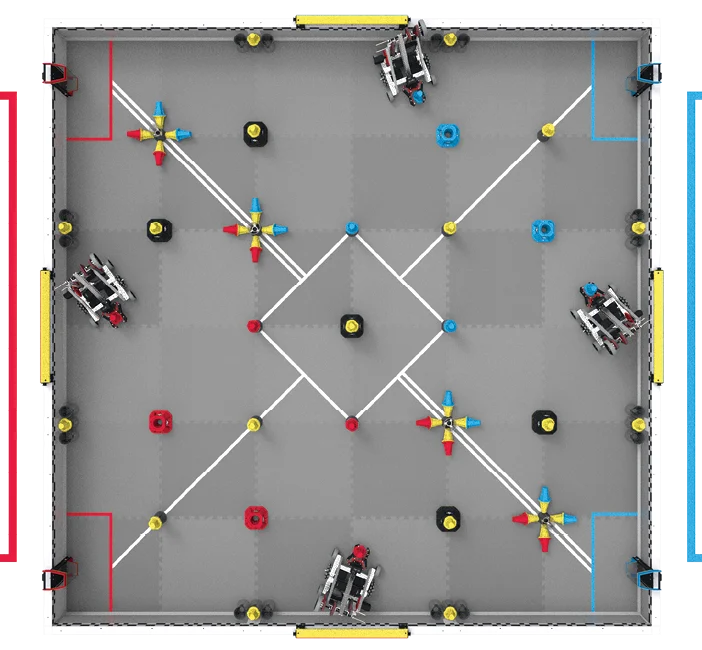
<SG2> Horizontal expansion is limited
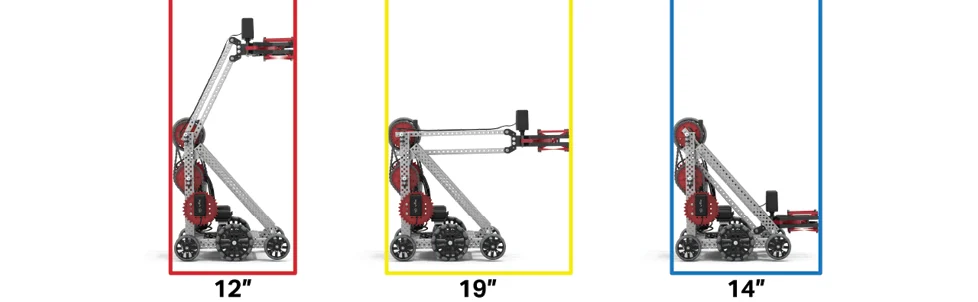
Once the match begins, robots can expand beyond the 18″ x 18″ starting size, but it can never be larger than 24″ wide x 24″ long. (The robot must always be able to fit inside a 24″ x 24″ square.
Be prepared to demonstrate that your robot never exceeds the maximum size during inspection.
<SG3> Vertical expansion is limited
The robots must begin each match with dimensions smaller than 18″ x 18″ x 18″. Once the match starts, robots may expand vertically as long as they don’t exceed an overall height of 50″ at any point in the match. However, during the endgame (last 10 seconds of the match) vertical expansion is limited to 18″ for any robot partly or completely in the midfield.
<SG4> Keep scoring objects in the field
You may not intentionally or strategically remove pins or cups from the field. If a scoring element does leave the field during a match (intentionally or unintentionally), it will be returned to the field near where it left (in contact with the tiles and perimeter but not touching any other objects or robots).
Any team who removes 3 or more pins or cups from the field in a single match will immediately receive a major violation (disqualification).
<SG5> Each robot gets one pin as a preload
Prior to the start of each match, teams may each place one preload pin (red/yellow for the red alliance and blue/yellow for the blue alliance) so that it:
- touches only one robot of their alliance
- does not touch the same preload as another robot
- is not touching or within a goal, loader, load zone, or toggle
<SG6> Robots may only possess one pin and one cup
A robot can posses a maximum of 1 cup and 1 pin. An object is considered possessed by a robot if a change in direction of the robot would result in controlled movement of the object. This is often because:
- the robot is carrying the object
- the object is in a concave section of the object
- the robot is holding the object against the tiles or a field element
Plowing (pushing) multiple pins and cups with a flat or convex part of your robot is allowed.
<SG7> Don't cross the autonomous line (during the autonomous period)
Robots cannot cross the autonomous line (the double white tape line running across the middle of the field) during the autonomous period. Doing so will result in the opposing alliance receiving the the 12 point bonus. If both alliances cross the line, no points will be awarded to either alliance.
Intentionally disrupting an opponent’s robot actions or contacting the opponent’s robot will result in violations.
<SG8> Engage with the autonomous line at your own risk
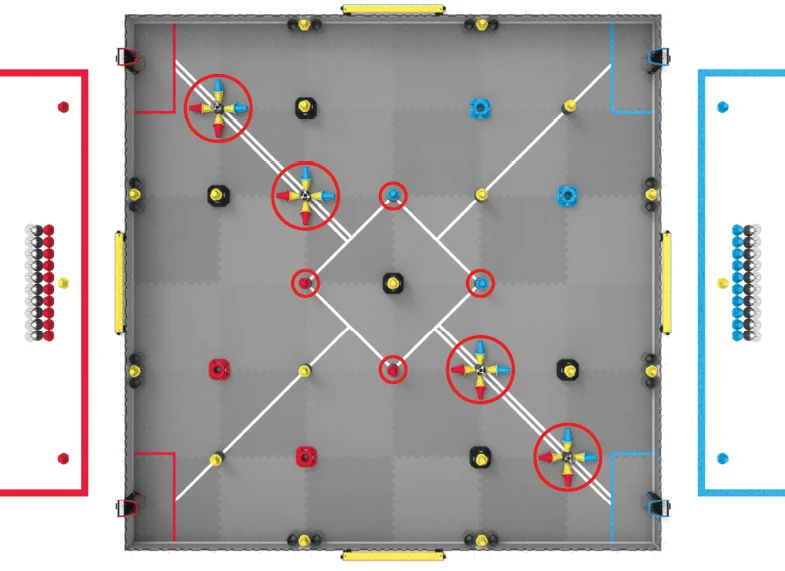
Robots are allowed to touch any of the 20 scoring objects placed on the autonomous line (circled in red in the image below). Robots may also enter the midfield. These interactions are “at your own risk”. This means you should expect that your opponents may do the same thing.
Robots cannot contact the pins or cups on the other side of the autonomous line or robots on the opposing alliance’s side unless the opponent is interacting with the autonomous line or midfield. This would result in the opposing alliance receiving both the 12 point autonomous bonus AND an autonomous win point.
Intentional, strategic, or egregious violations will be considered major violations and should result in a disqualification from the match.
<SG9> Alliance Goals are protected
Robots cannot directly or indirectly interact with the opponent’s alliance-colored goals. This includes adding or removing scoring objects.
Incidental contact with opponent’s goals or placed pins and cups in that goal is a minor violation.
All other interactions (including adding or removing cups or pins) is a major violation and DQ.
<SG10> Scoring objects cannot be removed from neutral or opponent goals
Robots can only remove placed scoring objects from their own alliance-colored goal.
<SG11> Match loads may be introduced during the match
While introducing pins and cups into the loader, a drive team member’s hand can temporarily break the plane of the field perimeter.
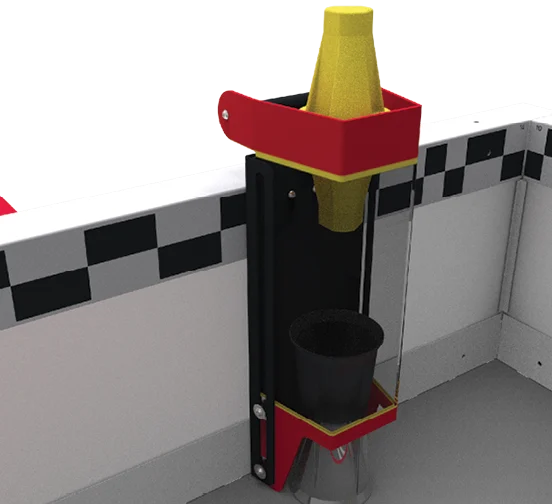
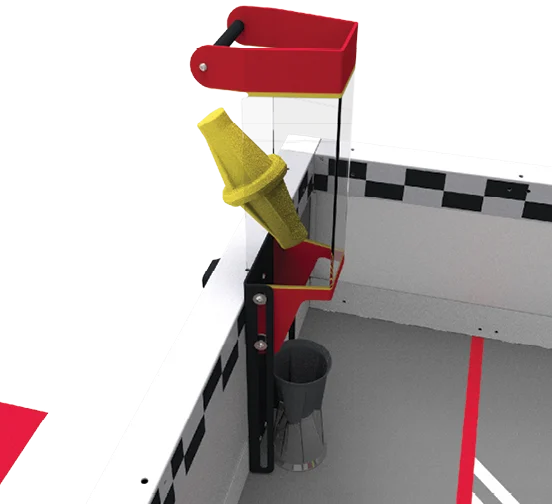
You may place a single pin, a single cup, or a nested cup and pin into the top of the loader (when the loader is in the “down” position) or the back of the loader (when the loader is in the “up” position). Scoring objects can be placed into either of the loaders on your alliance station side and only during the diver controlled period of a match. Match loads cannot be touched by a robot before being placed into the loader, and can only be removed from the loader by an alliance robot through the bottom opening of the loader.
<SG12> Endgame Rules
During the endgame (last 10 seconds of the match) vertical expansion is limited to 18″ for any robot partly or completely in the midfield.
Robots that attempt to end the match in the midfield should expect vigorous interactions from their opponents. Incidental damage caused by pushing, tipping, or entanglement would not be considered a violation of <GG14>. Intentional damage or dangerous mechanisms may be considered a violation of <S1> or <G1> at the discretion of the head referee.
Assignment:
Go to the V5RC Drive Team Training Course and complete the Unit 5 Quiz.
If you miss any of the questions, now is the time to figure out why. Look back through the rules and the information listed in this session for clarification.